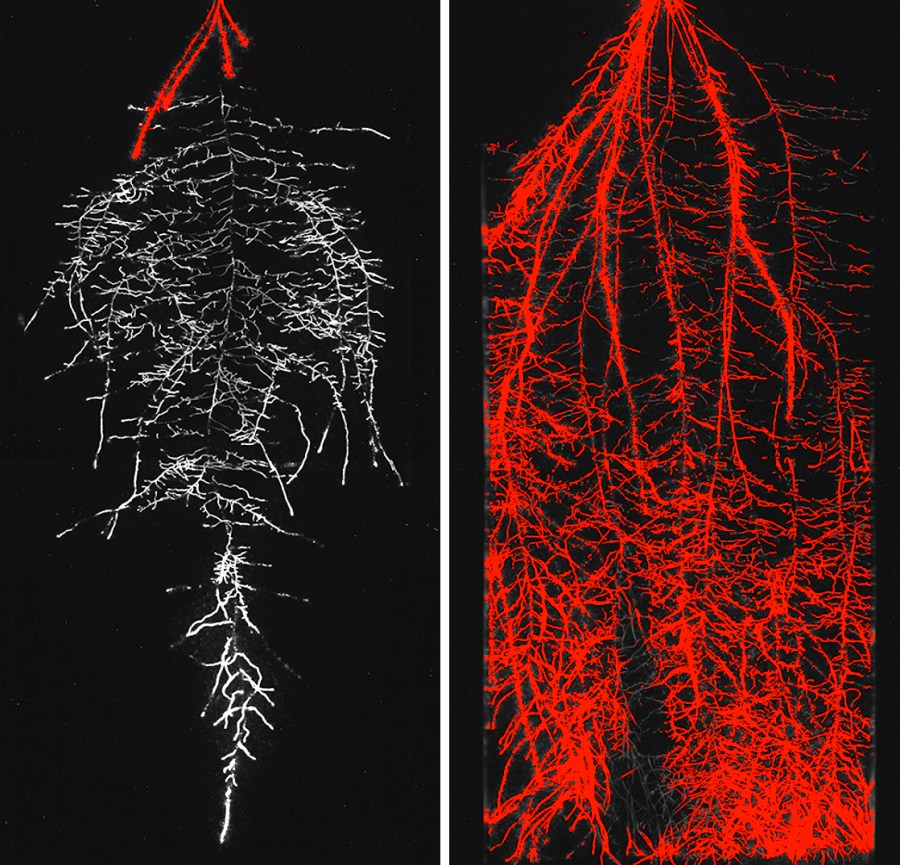
Grasses build most of their root system from crown roots that emerge at the base of the shoot. Jose Sebastian and colleagues showed that when the surface soil dries, these roots stop developing, which limits water uptake and leaves reserves in the soil for later — a kind of austerity measure. The suppression is reversible: crown roots resume growth when moisture returns. Comparing wild grasses with domesticated maize showed the response is weaker in crops, suggesting breeding has eroded a drought-coping behavior that could be recovered.
Coverage: Carnegie Science | BBC News
Sebastian J, Yee MC, Viana WG, Rellán-Álvarez R, Feldman M, Priest H, Trontin C, Lee T, Jiang H, Baxter I, Mockler TC, Hochholdinger F, Brutnell TP, Dinneny JR (2016) Grasses suppress shoot-borne roots to conserve water during drought. Proc Natl Acad Sci USA 113(31):8861-8866. doi: 10.1073/pnas.1604021113

