Cell wall–membrane anchors keep plant cells resilient during drought

Arabidopsis thaliana grown in the Dinneny lab. Image: Yue Rui

When cells lose water, the plasma membrane pulls away from the cell wall except at attachment points first described more than a century ago as Hechtian strands. Yue Rui and colleagues identified the molecular basis of these attachments: cellulose synthase complexes establish them, while remorin proteins limit their number. Plants with more attachment points recover better from osmotic stress, revealing a tunable structural mechanism of drought resilience. The work was done with Peter Dahlberg and collaborators at Carnegie, Aarhus, Rutgers, Freiburg and UNC.

Coverage: Stanford Report | Phys.org

Rui Y, Zaoralova M, Dwyer W, Reyes AV, Grismer TS, Abel NB, Jayachandran D, Chundawat SPS, Ott T, Kieber JJ, Dahlberg PD, Xu S-L, Dinneny JR (2026) Plant cell wall-plasma membrane attachments mediate stress resilience through cellulose synthase complexes and remorins. Cell. doi: 10.1016/j.cell.2026.05.009 | free access link

Corn varieties differ widely in how their roots seek water

Johannes Scharwies and José Dinneny with corn grown to study root responses to moisture at the Stanford greenhouses. Image: LiPo Ching, Stanford University

Johannes Scharwies and colleagues surveyed maize breeding germplasm for hydropatterning, the ability of roots to place branches toward available water, and found large differences among lines: tropical-adapted varieties retained a strong response that many modern U.S. lines have lost. Genetic and transcriptomic analysis identified the hormone ethylene, acting alongside auxin, as a regulator of moisture-responsive root branching, pointing to pathways that could be used to breed more drought-resilient corn.

Coverage: Stanford Report

Scharwies JD, Clarke T, Zheng Z, Dinneny A, Birkeland S, Veltman MA, Sturrock CJ, Torres-Martinez HH, Viana WG, Khare R, Kieber J, Pandey BKK, Bennett MJ, Schnable PS, Dinneny JR (2025) Moisture-responsive root-branching pathways identified in diverse maize breeding germplasm. Science. doi: 10.1126/science.ads5999 | free access link

Synthetic genetic circuits reprogram how roots grow

Synthetic genetic circuits designed to rewire gene expression in plant roots. Image: Jennifer Brophy

Jennifer Brophy led the design of synthetic genetic circuits that perform Boolean logic in plant cells, using synthetic transcription factors and promoters to control where and when genes are expressed. By wiring the circuits to a regulator of lateral root development, the team altered the number and density of root branches in Arabidopsis in a predictable way, establishing a framework for building root systems tailored to specific soils and climates.

Coverage: Stanford Report | Science Perspective by Alamos and Shih

Brophy JAN, Magallon K, Duan L, Zhong V, Ramachandran P, Kniazev K, Dinneny JR (2022) Synthetic genetic circuits as a means of reprogramming plant roots. Science 377:747-751. doi: 10.1126/science.abo4326

Extreme plants grow faster in the face of stress

Schrenkiella parvula thrives in extremely salty conditions. Image: José Dinneny

Most plants slow growth when the stress hormone abscisic acid (ABA) accumulates. In the extremophyte Schrenkiella parvula, a relative of Arabidopsis native to saline soils, ABA instead promotes growth. Ying Sun and colleagues traced this reversal to a rewired ABA-responsive gene regulatory network, showing that divergence in a conserved stress network can switch growth control from a brake to an accelerator. The work points to regulatory changes that could be used to engineer crops that tolerate degraded and saline soils.

Coverage: Stanford Report

Sun Y, Oh DH, Duan L, Ramachandran P, Ramirez A, Bartlett A, Dassanayake M, Dinneny JR (2022) Divergence in a stress-associated gene regulatory network underlies differential growth control. Nature Plants 8:549-560. doi: 10.1038/s41477-022-01139-5

Sebastian and Yee et al. highlighted by BBC

Ever wonder how plant roots respond to drought?  You probably thought it would be super complex.  Turns out a simple change in the development of shoot-borne roots explains much of the architectural differences.  In a new paper from the lab published in PNAS we described how grass species suppress crown root growth to slow the extraction of water from soil and preserve this precious resource for a longer time.  We think this may allow grass plants to better survive drought.  Interestingly, maize and millet still make some crown roots under drought and this may make these domesticated plants more water hungry.  Check out the highlight of this work in the BBC!

Crop roots enact austerity measures during drought to bank water

Crown roots emerging from the base of the shoot in a grass seedling.

Grasses build most of their root system from crown roots that emerge at the base of the shoot. Jose Sebastian and colleagues showed that when the surface soil dries, these roots stop developing, which limits water uptake and leaves reserves in the soil for later — a kind of austerity measure. The suppression is reversible: crown roots resume growth when moisture returns. Comparing wild grasses with domesticated maize showed the response is weaker in crops, suggesting breeding has eroded a drought-coping behavior that could be recovered.

Coverage: Carnegie Science | BBC News

Sebastian J, Yee MC, Viana WG, Rellán-Álvarez R, Feldman M, Priest H, Trontin C, Lee T, Jiang H, Baxter I, Mockler TC, Hochholdinger F, Brutnell TP, Dinneny JR (2016) Grasses suppress shoot-borne roots to conserve water during drought. Proc Natl Acad Sci USA 113(31):8861-8866. doi: 10.1073/pnas.1604021113

Plant scientists: GM technology is safe

Word cloud from the signatories’ statement on genetic modification.

Writing in Science, José and colleagues argued that the evidence on genetically modified crops is clear enough to act on: the technology is a safe and useful tool among the several that will be needed to meet food supply demands, and public debate should reflect that scientific consensus rather than contradict it. The letter was signed by a large number of plant scientists.

Coverage: Carnegie Science

Fahlgren N, Bart R, Herrera-Estrella L, Rellán-Álvarez R, Chitwood DH, Dinneny JR (2016) Plant scientists: GM technology is safe. Science 351(6275):824. doi: 10.1126/science.351.6275.824-a

GLO-Roots: a firefly protein makes roots visible in soil

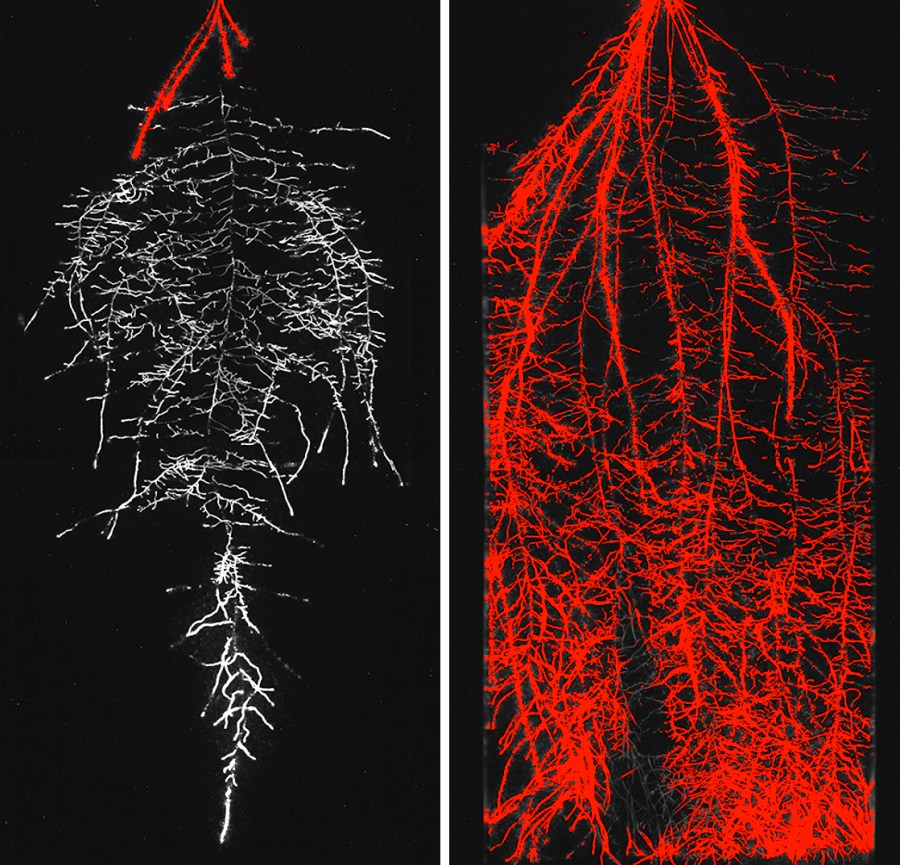
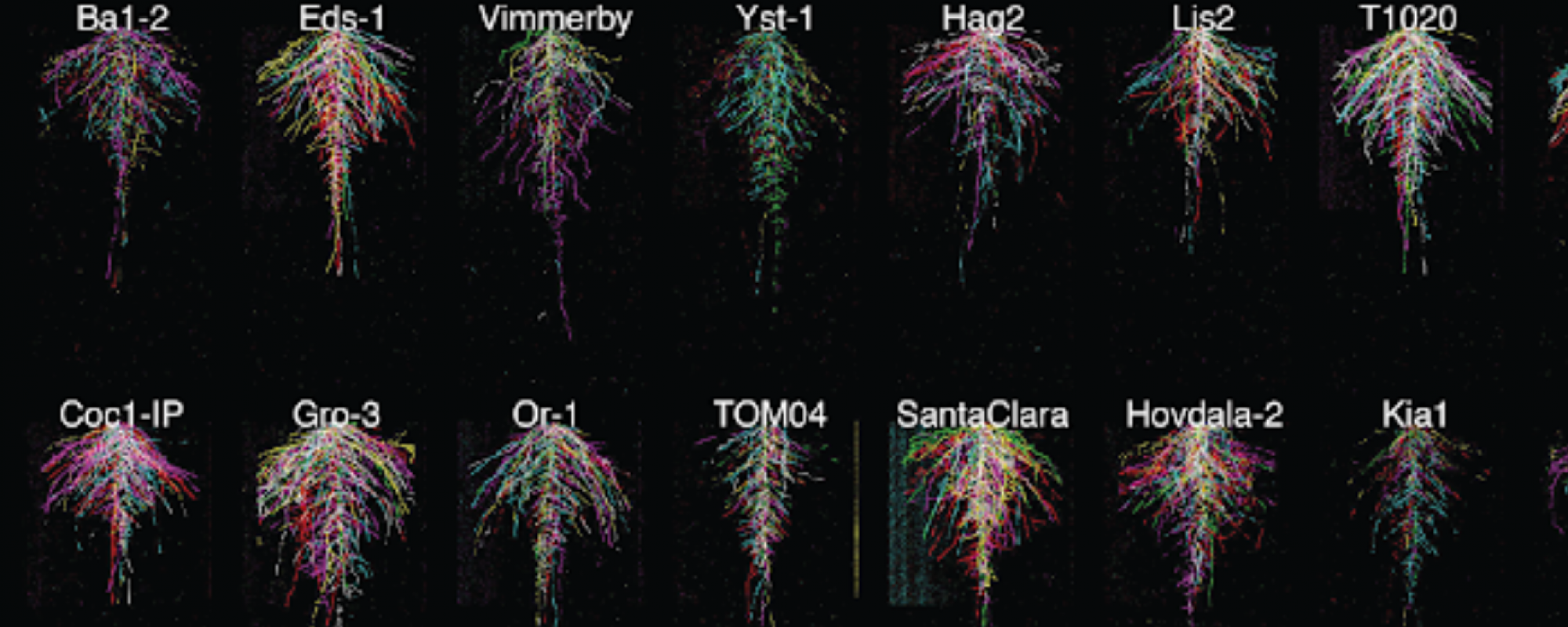
Most of what is known about root development comes from plants grown on transparent agar, a poor substitute for soil. Rubén Rellán-Álvarez and colleagues developed GLO-Roots, which expresses luciferase in the root and images the resulting light through soil in flat rhizotrons. The system captures whole, intact root systems over weeks, and separate luciferases allow root architecture, gene expression and interactions between neighboring plants to be followed at the same time. It brings quantitative imaging to root systems growing in a realistic environment.

Coverage: Carnegie Science | Nature Methods

Rellán-Álvarez R, Lobet G, Lindner H, Pradier P-L, Sebastian J, Yee MC, Geng Y, Trontin C, LaRue T, Schrager A, Haney C, Nieu R, Maloof J, Vogel JP, Dinneny JR (2015) GLO-Roots: an imaging platform enabling multidimensional characterization of soil-grown root systems. eLife 4:e07597. doi: 10.7554/eLife.07597

Hydropatterning: water provides the blueprint for root architecture

Roots do not branch at random. Yu Bao and colleagues showed that a root in contact with moisture on one side places its lateral branches on that side and suppresses them on the dry side, a behavior the lab named hydropatterning. The response is set locally, through auxin biosynthesis and transport, and operates independently of the general stress signaling triggered by water deficit. It occurs in soil as well as in the laboratory, and in grasses as well as Arabidopsis, indicating a broadly conserved mechanism for placing roots where water is.

Coverage: Carnegie Science

Bao Y, Aggarwal P, Robbins NE II, Sturrock CJ, Thompson MC, Tan HQ, Tham C, Rodriguez PL, Vernoux T, Mooney SJ, Bennett MJ, Dinneny JR (2014) Plant roots employ a patterning mechanism to position lateral root branches toward available water. Proc Natl Acad Sci USA 111(25):9319-9324. doi: 10.1073/pnas.1400966111